
Why Political Science? The Science of Democracy: Resources for APSA Members in Times of Political and Institutional Upheaval
Why Political Science? The Science of Democracy
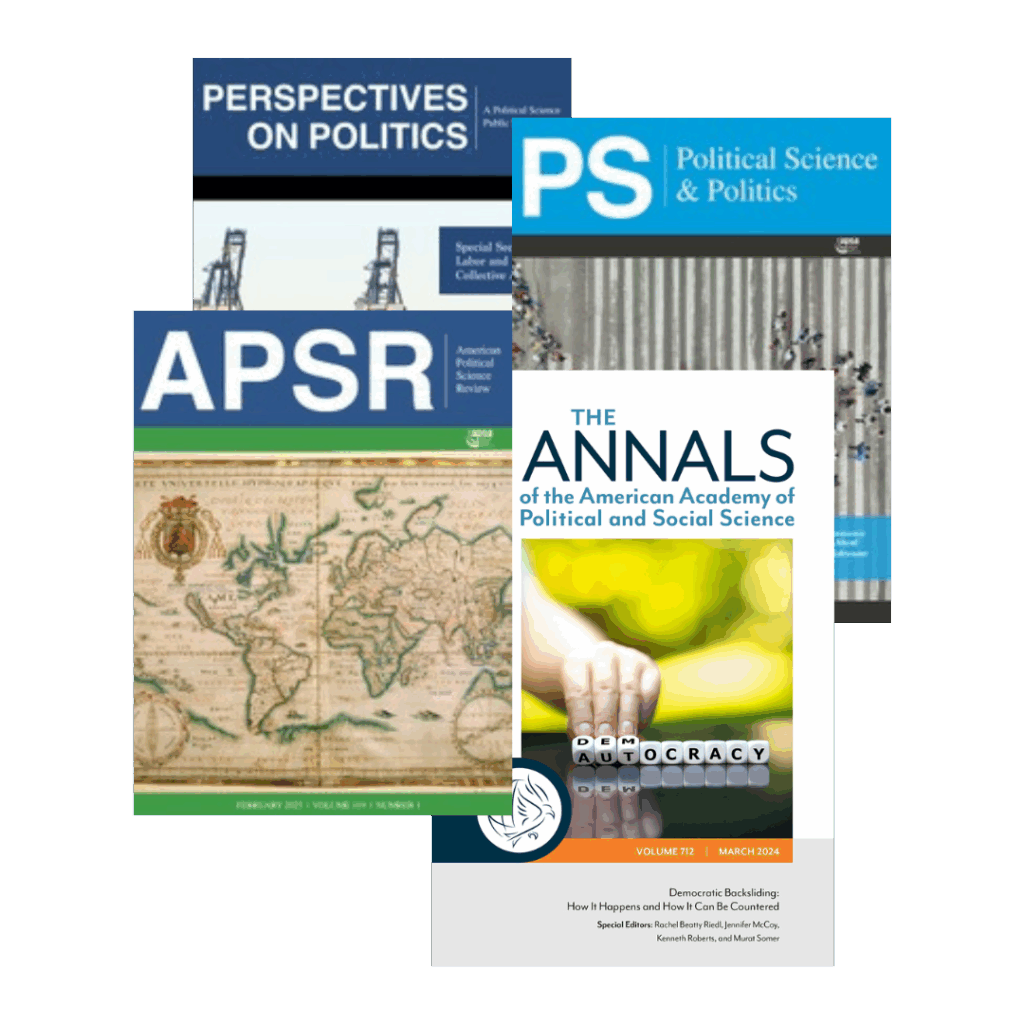
Political scientists have long examined questions of democracy, authoritarianism, and democratic backsliding. This scholarship has made an invaluable contribution to our discipline and to public discourse that can help us understand the current political climate in the United States as well as political events globally. Below is a collection of resources and scholarly work from political scientists and a variety of other sources, that we hope you will engage. Additionally, we have provided ungated access to articles from the journals of the American Political Science Association that address these important questions.
Political science instructors are at the forefront of engaging students – at the undergraduate and graduate level – with these questions. Political scientists face both challenges and opportunities in the classroom as the current political climate evolves. This resource collection includes resources for teaching and will include information on upcoming APSA events.
We encourage you to share your own resources to add to these collections using this form. If you have any questions about this page, contact teaching@apsanet.org.
Research and Resources for Understanding Democracy, Democratic Backsliding, and Authoritarianism
Authoritarianism and Democratic Backsliding: From APSA Journals
- Voting in Authoritarian Elections | Turkuler Isiksel and Thomas Pepinsky (OA)
- The Resilience of Democracy’s Third Wave | Steven Levitsky and Lucan Way ((OA)
- Populism and Democracy: The Road Ahead | Cristóbal Rovira Kaltwasser and Paul Taggart (OA)
- The Effect of Populist Incumbents on Democracy | Kirk A. Hawkins and Grant A. Mitchell (OA)
- An Events-Based Approach to Understanding Democratic Erosion | Hannah Baron, Robert A. Blair, Jessica Gottlieb, Laura Paler (OA)
- Elite Change without Regime Change: Authoritarian Persistence in Africa and the End of the Cold War | Josef Woldense and Alex Kroeger (OA)
- Democratic Subversion: Elite Cooptation and Opposition Fragmentation | Leonardo R. Arriola, Jed DeVaro, Anne Meng
- The Non-Democratic Roots of Mass Education: Evidence from 200 Years | Agustina S. Paglayan (OA)
- Rising Threats to U.S. Democracy | Theda Skocpol (UNG)
- Safeguarding Democracy: Powersharing and Democratic Survival | Benjamin A.T. Graham, Michael K. Miller, and Kaare W. Strøm
- Rationalizing Democracy: The Perceptual Bias and (Un)Democratic Behavior | Suthan Krishnarajan (UNG)
- When Does Backsliding Lead to Breakdown? Uncertainty and Opposition Strategies in Democracies at Risk | Matthew R. Cleary and Aykut Öztürk (UNG)
- Forging, Bending, and Breaking: Enacting the “Illiberal Playbook” in Hungary and Poland | Andrea L. P. Pirro and Ben Stanley (OA) (UNG)
- Populism’s Threat to Democracy: Comparative Lessons for the United States | Kurt Weyland (UNG)
- Democratic Decline in the United States: What Can We Learn from Middle-Income Backsliding? | Robert R. Kaufman and Stephan Haggard (UNG)
Corrupting the Cyber-Commons: Social Media as a Tool of Autocratic Stability | Seva Gunitsky (UNG) - Overruling the Executive: Judicial Strategies to Resist Democratic Erosion | Benjamin Garcia-Holgado (OA)
(OA) = Open Access
(UNG) = Ungated Article
Data Sets
Political Resistance and Autocracy
Research and Resources for Understanding America’s Democratic Crisis
From APSA Journals
- Laboratories of Democratic Backsliding | Jacob M. Grumbach (OA) (UNG)
- Senate Countermajoritarianism | C. Lawrence Evans (OA) (UNG)
- Executive Power in Crisis | Kenneth Lowande and Jon C. Rogowski
- The President Will See Whom Now? Presidential Engagement with Organized Interests | David Ryan Miller
- Does Public Opinion Constrain Presidential Unilateralism? | Dino P. Christensen and Douglas L. Kriner
- Efficacy of Congressional Oversight | Pamela Ban and Seth J. Hill (OA)
- How the Trump Administration’s Quota Policy Transformed Immigration Judging | Elise N. Blasingame, Christian L. Boyd, Roberto F. Carlos, and Joseph T. Ornstein
- Activating Animus: The Uniquely Social Roots of Trump Support | Lilliana Mason, Julie Wronski, and John V. Kane
- Gone For Good: Deindustrialization, White Voter Backlash, and US Presidential Voting, Leonardo | Baccini and Stephen Weymouth
- Democracy in America? Partisanship, Polarization, and the Robustness of Support for Democracy in the United States | Matthew H. Graham and Milan W. Svolik
- How to Sound the Alarms: Untangling Racialized Threat in Latinx Mobilization| Vanessa Cruz Nichols and Ramón Garibaldo Valdéz
- Polarized Toward Apathy: An Analysis of the Privatized Immigration-Control Debate in the Trump Era | Emily P. Estrada, Kim Ebert, and Weinjie Liao
(OA) = Open Access
(UNG) = Ungated Article
From Other Journals (non-APSA journals)
Historical Roots and Origins
- Democratic Vulnerabilities and Pathways for Reform | Suzanne Mettler, Robert C. Lieberman, Jamila Michener, Thomas B. Pepinsky, Kenneth M. Roberts
- The January 6th, 2025, Project: Fascist Politics and the Rising Threats to American Democracy | Matthew E.K. Hall
- The Crisis of American Democracy in Historical Context | Suzanne Mettler, Robert C. Lieberman
Polarization, Inequality, and Federalism
- Does Affective Polarization Contribute to Democratic Backsliding in America? | James N. Druckman, Donald P. Green, Shanto Iyengar
- American Federalism, Political Inequality, and Democratic Erosion | Jacob Grumbach and Jamila Michener
- Which States Adopt Election-Subversion Policies? | Jacob M. Grumbach and Charlotte Hill
- United States: Racial Resentment, Negative Partisanship, and Polarization in Trump’s America | Alan Abramowitz and Jennifer McCoy (OA)
Race, Gender, and Class
- White Racial Solidarity and Opposition to American Democracy | Ashley Jardina and Robert Mickey
- Can Black Lives Matter within U.S. Democracy? | Megan Ming Francis
The Judicial Branch
(OA) = Open Access
Resources for Teaching Politics and Civics in Times of Uncertainty
Teaching Civic Engagement
Teaching about Democracy, Authoritarianism, and Democratic Backsliding
- APSA Educate Resources
- Robert Kaufman, Lydia Khalil, Peter Woodrow, James Paterson – Understanding Democratic Erosion: A Systems Interactive Map
- Robert Lieberman – Introduction to American Politics
- Jyl Josephson, American Political Thought
- Jyl Josephson, Democracy & Citizenship
- Rogers Smith, Modern American Constitutional Law
- Teaching Comparative Politics Resource Collection
- Journal of Democracy Subject Guide
- University of Michigan Institute for Social Research Teach-In:
Classroom Management and Respectful Conversations
- Preventing a Crisis in the Political Science Classroom: De-escalation Tips for College Instructors | Elizabeth A. Bennion
- Civil Discourses: Helping Students to Become Conversation Partners | Elizabeth A. Bennion
- Teaching Students to Hear the Other Side: Using Web Design and Election Events to Build Empathy in the Political Science Classroom | Leslie Caughell
- Promoting Productive Political Dialogue in Online Discussion Forums | Aaron S. King, J. Benjamin, and Taylor, Brian M. Webb
Civic Learning Strategies Across Higher Education