
Diversity and Inclusion Resources
APSA values diversity, equity, and inclusion. The APSA strategic plan states that one of APSA’s overarching goals is to promote and encourage diversity and inclusion in the profession, to identify and remove systemic barriers to participation, and advance the early careers of scholars who focus on underserved community groups and understudied topics in the political science discipline. Diversity and inclusion features prominently in association’s strategic theory of change.

Actively inclusive and equitable practices should be encouraged and modeled across the discipline, and at all levels — and especially within the recruitment, retention and advancement of scholars who focus on historically underrepresented communities or topics understudied in the discipline. APSA has identified diversity and inclusion as one of the association’s critical opportunities and challenges for 2024-2026, with the goal of continuing to broaden and deepen programming on diversity and inclusion throughout the association and building a climate of RESPECT. The intended outcomes are increased diversity, inclusion, and access within the discipline of political science across all levels and at APSA meetings and events, including leadership, governance, program development, annual meeting, teaching and learning conference, and workshops and events.
The following is a list of resources for advancing and promoting diversity and inclusion within the discipline. If you have suggestions for additional resources, please email us at diversityprograms@apsanet.org.
| Diversity Diversity is broadly construed as a collection of individuals and groups from a wide-ranging set of backgrounds and experiences, who employ a variety of approaches to an issue, problem or their worldview. Specifically, diversity can include differences in race, ethnicity, gender and gender identity, sexual orientation, ability, and other important forms of diversity such as geographic distribution, field of professional interest, methodological orientation, and types of institutions where members are employed, among other things. Read the Diversity and Inclusion Report 2018 | Summary Data Update 2022 | Equity Equity refers to fair, impartial, and just treatment, access, and “…opportunity, and advancement for all people, while at the same time striving to identify and eliminate barriers that have prevented the full participation of some groups.” | Inclusion Inclusion is the “the active, intentional, and ongoing engagement of our diversity” in an equitable manner. Inclusion also involves creating a welcoming and safe environment, culture, and climate that values and promotes respect for all. |
.png?ver=nnXB1hyxCokBHrku16t8nQ%3d%3d "Home-Banner (4)")
DEI and Anti-harassment Micro Training Videos by NAVEX

Recruitment and Retention
.png?ver=8RwYBwOnLZA_dU3HjQebYQ%3d%3d "Departmental Services Program (1)")
Teaching Resources
- Systemic Racism & Racial and Social Justice
- APSA Educate
- Politics, Power, & Group Differences: Teaching about Charlottesville
- Incorporating Diverse Themes into the Classroom
- Syllabi for Teaching Diversity Related Themes
- Indigenous Politics Content Syllabus – Canadian Political Science Association Reconciliation Committee
637546289025109060.png?ver=cOcjZJq8RNQsalPU-SQ9Nw%3d%3d "Untitled design (1)637546289025109060")

Call for Applications: Minority-Serving Institution Virtual Book Workshop Project
637994679466041733.png?ver=s1tmCT0EelPjIyND7dzM8Q%3d%3d "Twitter Graphics (3)637994679466041733")
Applications for the 2024 Cycle are now closed.
Book workshops produce great books, but too few scholars have access to the resources needed to organize and execute one, especially scholars at Historically Black Colleges and Universities, Hispanic Serving Institutions, Asian American and Pacific Islander Serving Institutions, and Tribal Colleges and Universities. Thus, this inequity harms faculty who have dedicated their careers to teaching at Minority Serving Institutions (MSIs). University of Maryland, College Park professor, Dr. Niambi Carter, and John Jay College professor, Dr. Heath Brown, co-direct the project and have organized a review board to select deserving manuscripts for the competitive awards across fields of study.
During the 2021 American Political Science Association (APSA) Annual Meeting, a new project launched to support virtual book workshops for scholars at Minority-Serving Institutions (MSI) in the United States. The program is now in its second year. The goal of the MSI Virtual Book Workshop Project is to help scholars of politics at MSIs publish great books. Workshops of expert reviewers give authors extensive feedback to improve a completed manuscript as well as insights into the publication process. Unfortunately, workshops have been too expensive for many scholars to benefit from, especially at MSIs.
For more information, please visit here.
Videos Featuring APSA Diversity and Inclusion Programs
637546294404538807.png?ver=eOQq_zoNvqdFaYwswa-e3g%3d%3d "Untitled design (4)637546294404538807")
637546295148428014.png?ver=GiSkmoGnGSv3lO8M9pgq3A%3d%3d "Untitled design (7)637546295148428014")
- Virtual RBSI Research Methods Course. “Introduction to Empirical Methods” Lectures by Professor David Siegel. Go directly to the syllabus.
637546294893912155.png?ver=u0ols2ZAbgACuBqjCI89Rg%3d%3d "Untitled design (6)637546294893912155")
637546294594870799.png?ver=82lFfDPTJo_--PyBTK9gDQ%3d%3d "Untitled design (5)637546294594870799")
Resource Spotlight
- Task Force on Systemic Inequalities – Videos and Webinars 2023-2024. Topics: Faculty recruiting and retention, Task Force recommendations, and Dr. Paula D. McClain’s presidential address.
- Mental Health Awareness Resources
- Recruiting and Retaining Faculty of Color Workshop 2021 – By Maricruz Osorio for POCAKS – People of Color Also Know Stuff
- Strategies and Resources for More Inclusive Syllabi and Classrooms
- NASEM National Academies of Sciences, Engineering, and Medicine. 2023. Advancing Antiracism, Diversity, Equity, and Inclusion in STEMM Organizations: Beyond Broadening Participation. Washington, DC: The National Academies Press. https://doi.org/10.17226/26803.
- 2020 APSA Election Reflections
- 2020 APSA Presidential Address – Dr. Paula D. McClain
- RBSI Advisory Committee Report and Recommendations 2019
637275863078795473.png?ver=2020-06-12-151828-037 "Untitled design (9)637275863078795473")
- APSA RESPECT Campaign
- APSA Resources on Systemic Racism & Social Justice
- Diversity and Inclusion Report 2018 | Summary Data Update 2020
- Diversity Recruitment and Retention
- APSA Diversity & Inclusion Programs Webinars for Students
- APSA Diversity and Inclusion Programs
- APSA Mentoring Program
- APSA Task Force Report: Political Science in the 21st Century
- Reducing the Impact of Bias in the STEM Workforce Report 2016 report by the Office of Science and Technology Policy (OSTP) and the Office of Personnel Management’s (OPM) Interagency Policy Group.
- Inclusive Language: Style and Usage – APSA Style Guide
- Diversity and Inclusion Advancing Research Grants
- Grants in the Discipline
- Search for STEM Research Programs and Opportunities Search over 1,500 programs for paid summer research programs, graduate programs, and postdocs in STEM. View the resource toolbox for tips on applying and use the online sign up form to receive notifications of programs that match your interests.
- RBSI Advisory Committee Report 2019 (includes list of summer research experience programs)
- A Virtual Review: Gender, Race, Ethnicity, and Diversity in American Political Science Association Publications
The Political Science in the 21st Century Report (2011), offered a number of recommendations to the discipline including several related to political science research on diversity and racial, ethnic, and gendered marginalization. To mark the fifth anniversary of this report, APSA invited the co-chairs to review to review a sample of the articles that have appeared in the association’s journals in recent years that engage issues of race and gender, to see where we are now in comparison to where we were in 2011. Read the Virtual Review Issue written by former APSA President, Dianne Pinderhughes and Maryann Kwakwa, both of the University of Notre Dame.
In 2018, in coordination with a discussion group of scholars whose teaching and research focuses on indigenous governance and politics, APSA collected resources on programs, journals, and networks for indigenous scholars in the profession and for scholars working on issues of sovereignty and tribal governance. This collaboration has lead to the creation of new APSA resource page. The group plans to continue its collaborative work and will focus future efforts on resource development for the discipline and recruitment and outreach to Indigenous Scholars.
- Strategies for an Inclusive Classroom
- Politics, Power, & Group Differences in the US: Teaching about Charlottesville & Related Topics
- Incorporating Diverse Themes into the Classroom
- Syllabi for Teaching Diversity Related Themes
- RBSI Research Methods Course — “Introduction to Empirical Methods” Lectures by Professor David Siegel
- Resources for Political Science Faculty
- Election Reflection Series
- APSA African American Political Scientists Oral History Project The African American Political Scientists Oral History Project contains interviews conducted between 1988-1994 of African American scholars. This resource is part of the Pi Sigma Alpha – APSA Oral History Project.
- Georgetown Center for New Designs in Learning and Scholarship
- The Case for Inclusive Teaching – the Chronicle of Higher Education
Political scientists have long examined the linkages between race, power, governance, social injustice and oppression. This scholarship has made an invaluable contribution to our discipline and to public discourse. It has illuminated the sources and structures of systemic racism, pervasive inequality and human rights abuses in the United States, as well as the resulting social, political, and public policy consequences.
This resource project acknowledges the issues and debates that have re-surfaced into the public discourse as a result of the murders of George Floyd, Breonna Taylor, Ahmaud Arbery at the hands of police, and the resulting protests and civil debates about social justice, race, systemic racism and public policy. With the understanding that these social, political, and economic themes predate the events and protests in Minneapolis, MN and the protests around globe.
Goals of this resource:- Highlight the range of scholarly expertise and contributions of political scientists whose research and public engagement addresses these important topics,
- Identify a diverse array of political science resources that can be brought to bear to assist students and faculty in the classroom and the public to better understand and dialogue about these issues in a constructive way.
- Acknowledge and appreciate that these themes are core and essential to the study of political science.
Data Dashboard
The APSA Research and Development team, in consultation with the APSA Diversity and Inclusion Programs team, has built a new data dashboard (or interactive data visualization) featuring APSA’s membership and organized section data. The APSA Status Committees and other APSA members provided feedback along the way.
Purpose: The data dashboard data will assist in the important work of learning more about APSA members and their interests. Secondly, the data will help APSA staff, the council, and the status committees identify and keep track of key trends in the profession, with regard to demographics, field of study, and organized section membership in order to meet our strategic goals. Additionally, members and member departments can use the data for reports to support projects at their home institutions, including establishing baseline information to support diversity recruitment, hiring, and retention efforts, and curriculum and departmental assessment. Finally, In addition to providing important demographic (race, ethnicity, and gender) and field of study data of APSA’s membership and organized sections, this data is a fulfillment of one of the key recommendations of the APSA Task Force on Political Science in the 21st Century Report, found here: http://apsanet.org/diversityresources.
Also on Data in the Profession page: jobs and departmental survey data, as well as data as external data on degree attainment and enrollment.
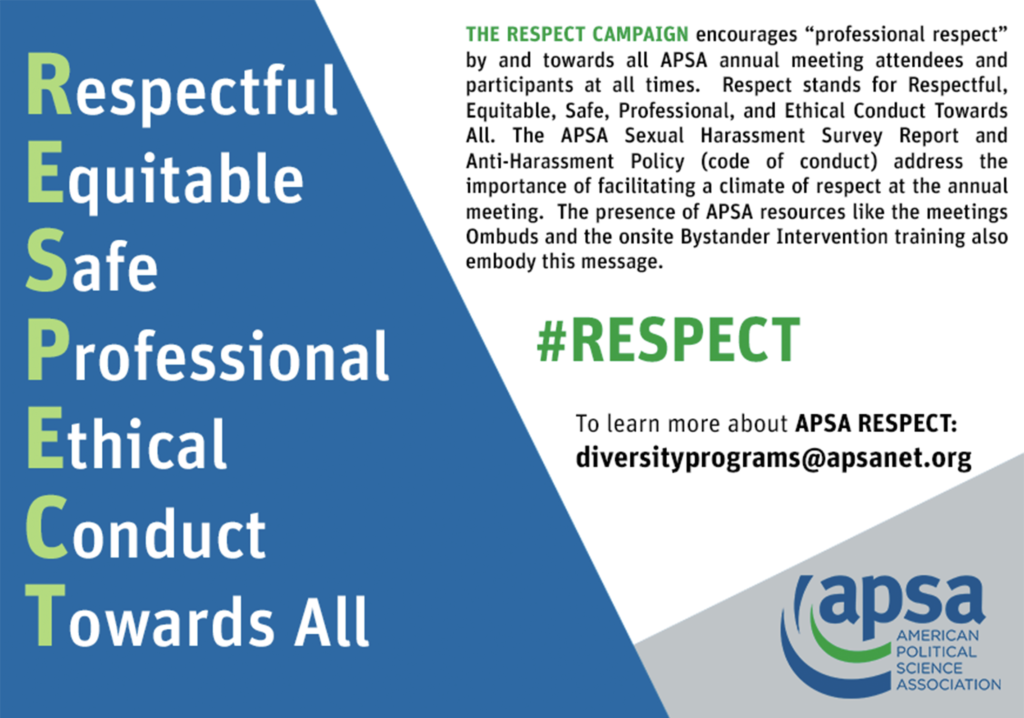
The APSA RESPECT Campaign encourages “professional respect” by and towards all APSA annual meeting attendees and participants at all times. Respect stands for Respectful, Equitable, Safe, Professional, and Ethical Conduct Towards All. The APSA Sexual Harassment Survey Report and Anti-Harassment Policy (code of conduct) address the importance of facilitating a climate of respect at the annual meeting.