Join Scholars at the 122nd APSA Annual Meeting & Exhibition | Boston, MA | September 3-6, 2026
Join political scientists for the 122nd APSA Annual Meeting & Exhibition in Boston, Massachusetts, September 3–6, 2026, to address the latest scholarship in political science and explore this year’s conference theme, “Democracy Under Threat: How to Understand, Protect, and Rebuild.”
Update on Proposed Dissolution of SBE Directorate at NSF Have you been funded by an NSF grant? Do you want to take action to protect political science research at NSF? APSA is working with partner organizations to identify strategies to advocate against the dissolution and defunding of SBE. Members of APSA who are willing and able to help advocate for social science funding at NSF may utilize or participate in any of the resources available here.
APSA Announces Renewed Partnership with Cambridge University Press The American Political Science Association (APSA) is pleased to announce that we have renewed our partnership with Cambridge University Press for the publication of the three member-wide APSA journals and six organized section journals.
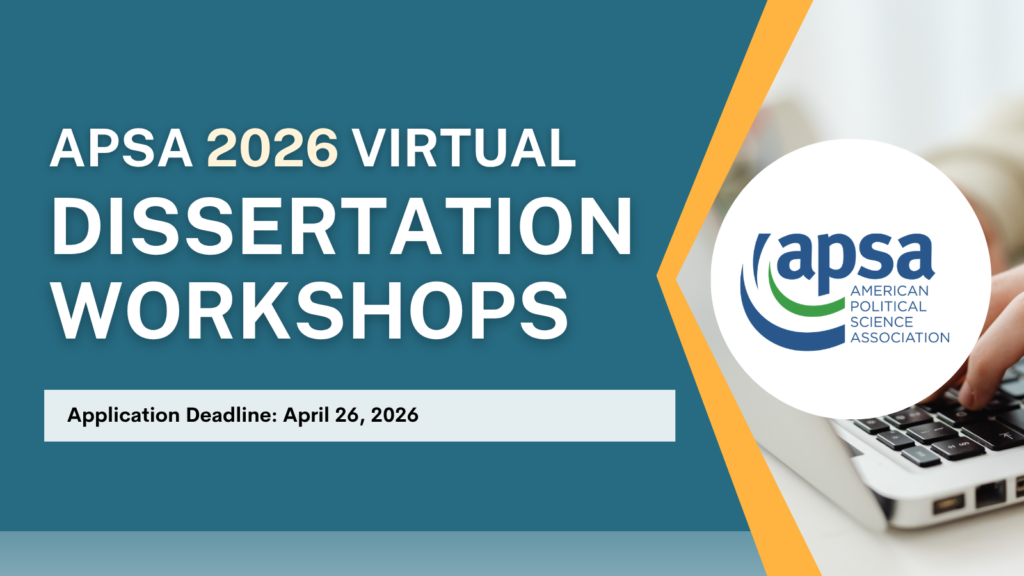
APSA sponsors in-person & virtual dissertation workshops annually. Our in-person events are held the Wednesday prior to the APSA Annual Meeting. Each full-day workshop includes six PhD candidates who present a dissertation chapter, along with two faculty members who lead the workshop and moderate discussions. Our virtual workshops are held over a two-week period during the summer.
‣ Call for Applications! APSA Advancing Research Grants – Early-Career Scholars
TheAPSA Diversity and Inclusion Advancing Research Grantsupports the advancement of research goals and professional development of early-career political science scholars. The grant will award scholars whose research areas focus on one of the following target research areas.
The grant will award scholars whose research areas focus on one of the following target research areas.
The APSA 2026 Doctoral Dissertation Research Improvement Grant (DDRIG) period is now open!This National Science Foundation-funded program provides support to enhance and improve the conduct of doctoral dissertation research in political science. Awards support basic research which is theoretically derived and empirically oriented.
Join the APSA Committee on the Status of Community Colleges in the Profession for Friday Faculty Hour session!
Come share inspirations for the new semester and check in as the Spring term begins. featuring committee member and host, Josh Franco, Cuyamaca College, and co-chair, APSA Committee on the Status of Community Colleges in the Profession.
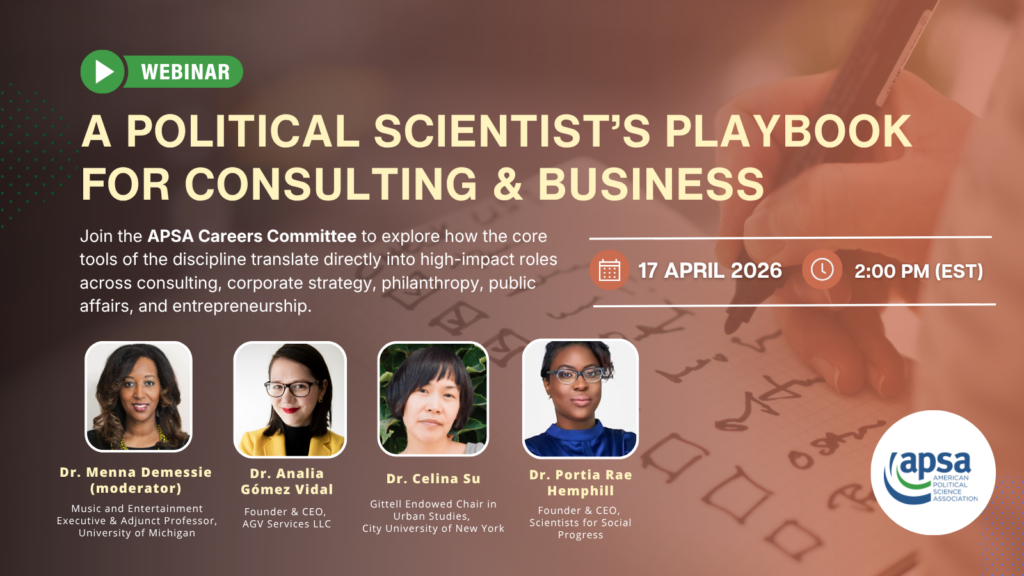
Join the APSA Careers Diversity Committee to explore how the core tools of the discipline—research and analysis, stakeholder mapping, policy design, data interpretation, strategic communication, and institutional assessment—translate directly into high-impact roles across consulting, corporate strategy, philanthropy, public affairs, and entrepreneurship.
‣ Thank You for Attending the 2026 APSA Virtual Research Meeting!
Thank you to all the 2026 Virtual Research Meeting participants, speakers, and attendees for making APSA’s inaugural Virtual Research Meeting a productive, enriching experience for all!
Get APSA Advocacy Updates Members can opt-in to receive updates on federal policy updates, events, and advocacy opportunities. Opt-in to receive routine updates from APSA’s Advocacy Program.
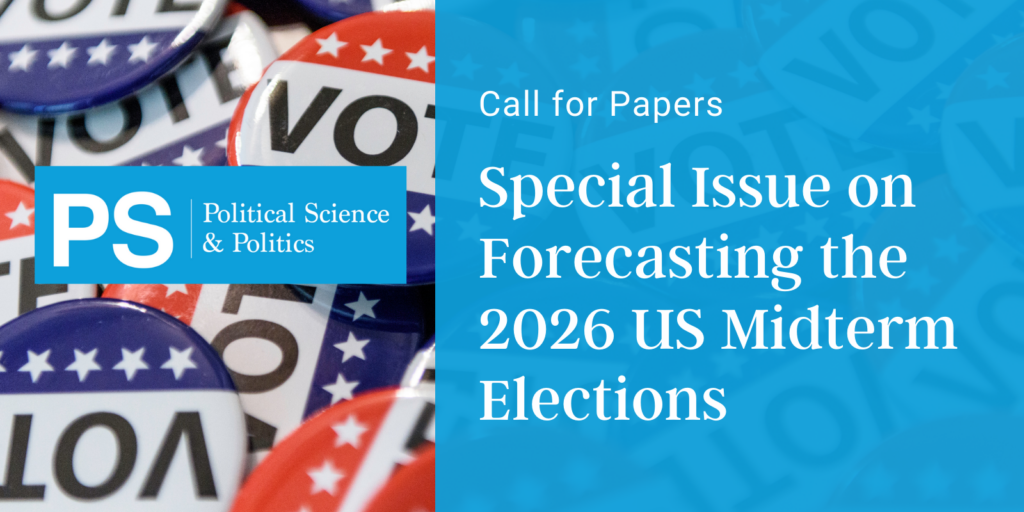
The 2026 US Midterm Elections present especially demanding conditions: mid-decade redistricting, concerns about political stability and violence, shifting macroeconomic signals, and intense polarization.
This special issue of PS: Political Science & Politics invites submissions that develop and evaluate forecasts suited to these dynamics, revisit the performance of long-run models under new stresses, or critically examine how forecasting is practiced and communicated. We welcome point and probabilistic forecasts for House, Senate, gubernatorial, or state legislative contests; turnout modeling (including participation among key socio-demographic groups); methodological advances such as model ensembling, synthetic/combined polls, crowd or market signals, uncertainty communication, and ML pipelines; comparative perspectives from other democracies; and reflective pieces on the limits, ethics, and public consequences of forecasting.
Meet APSA Member Spotlight, Risa Toha, Wake Forest University
“APSA has been so valuable for me throughout my career. At an earlier stage of my career, I went to APSA to present my research, meet new people, and learn about other people’s work. I have contacted people whose works I have admired for a long time and whom I view as giants in the field, to just ask if I could chat and meet with them over coffee after their panels.” — Risa Toha, Wake Forest University
APSA is proud to welcome the newly elected APSA Officers and Council Members. Officers and Council Members began their terms in September following the conclusion of the 2025 APSA Annual Meeting.
Meet the Doctoral Dissertation Research Improvement Grant (DDRIG) Awardees for 2025. The DDRIG provides support to enhance and improve the conduct of doctoral dissertation research in political science.
The Fund for Latino Scholarship encourages and supports the recruitment, retention, and promotion of political science students and scholars who study and research Latina/o politics.
The APSA Diversity and Inclusion Advancing Research Grants are open to all to provide research support that examines political science phenomena affecting underserved communities and underrepresented groups.
APSA is excited to recognize more than 100 APSA Organized Section awards honoring dissertations, papers, articles, books and career achievement. Organized Sections also recognize winners at their annual business meetings, which are held in conjunction with the APSA Annual Meeting.
‣ Why Political Science Matters: Resources for APSA Members in Times of Political and Institutional Upheaval
Find APSA member resources including resources on academic freedom, information about APSA’s annual meeting, member assistance, career resources, and more.
Explore collections of academic and public scholarship on democracy, democratic back-sliding, and the current crisis of American democracy. Find resources on teaching politics and civics in times of uncertainty.
The APSA Advocacy Program educates policy makers and the citizenry about political science scholarship and education. Learn about APSA’s advocacy programs, read APSA statements, and find action alerts.
‣ 2025-2026 Department Renewals are Open! Department members get a wide variety of benefits, including unlimited complimentary job listings on our eJobs platform. More benefits for a department membership can be found here.
‣ APSA Individual Memberships APSA offers individual memberships for current and retired faculty, students, K-12 educators, consultants, and researchers. APSA promotes scholarly research and discourse across the field of political science, while continuing to promote and expand professional opportunities.
‣ APSA Trial Memberships APSA has established a 90-day trial membership option to provide prospective members, including graduate students, and political science job seekers an introduction to APSA’s professional development and career resources. Trial Members gain access to eJobs, APSA’s online journals, and the all-member newsletter. Learn more and activate your trial membership here.










.JPG)