
eJobs Job Market Signaling
eJobs Job Market Signaling FAQ
Learn more: What is Preference Signaling and Why is it Used in Higher Education Job Markets?
How do I send a Signal to Employers?
eJobs Job Market Signaling FAQ
Job-seekers (or Candidates) FAQ
What does “Signaling” mean?
Preference signaling is a coordination mechanism to exchange information and improve job market outcomes (learn more here). The “Signaling form” allows APSA members to transmit or signal their interest in up to 3 jobs. After submissions are closed, APSA will transmit the signals to the corresponding departments.
Do I need to be an APSA member to have access to the Signaling form?
Yes, you must be an active APSA member to access the Signaling form. To join or renew your APSA membership, please see this page.
How do I send a signal to an employer?
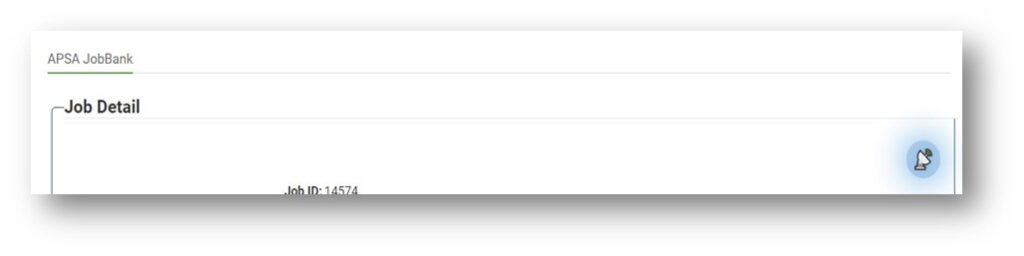
You must log in to eJobs and find the job posting you are interested in, then click on an active job posting and find the signaling icon in the upper-right corner. Once you click on the icon, you must enter all the information required to submit your signal. For more detailed step-by-step instructions, visit How do I send a signal to employers?
How many institutions can I send a signal to?
Jobseekers may choose as few as one (1) and as many as three (3) institutions/employers that they would like to signal their interests to.
How will I know if I was selected for an interview?
APSA does not guarantee that employers will reach out to candidates or guarantee or schedule meetings or interviews. We provide an initial private method to communicate preferences to employers to indicate a candidate’s intent/interest on a job posting. It is up to the employer to reach out to the candidate and set up an interview.
Can I attach my CV to the form?
No; however, jobseekers are encouraged to write a brief message (1-2 sentences, 250 characters) which can be used to show interest. Employers with an active listing can see the jobseeker’s CV when they log in to the eJobs website. Jobseekers are encouraged to use the Candidate section “My CV Listing” feature on eJobs to upload their CV and designate whether they are planning to use Interview Services at the Annual Meeting. More information about Interview Services is available here.
What if I am not able to attend the Annual Meeting?
We understand not all position openings have been made public and not all preferences for positions are known by the Annual Meeting. We hope to address this in future iterations of signaling. Signals that are submitted to employers that are not registered for interview services at the Annual Meeting will still be sent. APSA does not guarantee that jobseekers will receive an interview; signaling is an additional tool for jobseekers to show their interest in an advertised position.
Is the signaling tool only available for departments interviewing at the Annual Meeting?
All APSA members can utilize the signaling tool in order to let departments know that they are interested in the position advertised on eJobs. While the timeline for the current round focuses on providing attendees with a tool to signal their preferences for interviews at the Annual Meeting, signaling is available on all active eJobs listings.
How do I know if a Department is interviewing at the Annual Meeting?
On the eJobs JobBank page, candidates are able to access a list of departments that will be attending the Annual Meeting by filtering for only those listings that will be at the Annual Meeting.
What do I do at the Annual Meeting?
The APSA Annual Meeting offers jobseekers a relatively easy way to meet employers. Candidates can let employers know which days they are available to schedule in-person interviews through the eJobs Candidates feature. APSA offers space for employers to meet with candidates while on-site at the Annual Meeting. As always, APSA is not responsible for any scheduling or interview meetings during or after the Annual Meeting, as we fully leave interviews and scheduling up to the interviewer and the interviewee. The Signaling feature is a way to facilitate the exchange of information between both parties. In addition to submitting a signal, APSA recommends that candidates and employers continue to reach out to one another to schedule interviews while onsite.
What if I missed the deadline to submit my form (August 15th, 2025)?
Stay tuned to hear updates from APSA about signaling.
Who will receive my information?
Your personal information will only be transmitted to the employers you specify in your signaling form. APSA will not make your personal information public.
Should candidates who do not get interviews through this process be encouraged to still apply for jobs at the institutions they signaled?
Candidates who submit a signal but do not receive a response are encouraged to submit an application through the employer’s application process. No participant on either side is bound by a signal, either to offer an interview or to accept an interview. Candidates are advised to use eJobs to identify potential employers and contact employers they are interested in.
Employer FAQ
Do I need to sign up to receive signals?
No, employers do not need to register/sign up beyond the process they have completed to submit a job posting to eJobs and indicate their participation in Interview Services at the Annual Meeting. Signals from jobseekers, if any are made, will be sent to the position contact email address provided on the eJobs listing in the last week of August.
How much does it cost to sign up to receive signals?
There is no additional fee associated with the Signaling feature beyond the process employers have completed to submit their job posting(s) to eJobs. Employers who have a job posting on eJobs will receive an aggregated list of candidates who have expressed interest in their postings during the last week of August.
How do I set up an interview?
Employers are encouraged to reach out to the candidates that have signaled their interest through the Signaling feature or candidates they are interested in through the contact information the Candidate uploads into eJobs. All information provided through Signaling will be forwarded to employers. Employers can access other information on jobseekers, such as their CVs and whether they are available for interviews at the Annual Meeting, through the eJobs platform. More information for employers on Interview Services can be found here.
Can I interview candidates at the APSA Annual Meeting?
Employers are encouraged to use the APSA Interview Services at the Annual Meeting to set up interviews. Employers are responsible for reaching out to candidates and setting up interviews.
What is Preference Signaling and Why is it Used in Higher Education Job Markets?

What is preference signaling and how does it work in job markets?
Preference signaling is a coordination mechanism to exchange information and improve job market outcomes. Preference signaling, as part of candidate-host/employer matching job markets, stems from the market design literature in economics pioneered by game theory-oriented social scientists. “Signaling” is used by jobseekers and employers in specialized labor markets, including medical residents (as part of a matching program)[1] and economists (as part of the interview process), often as way for jobseekers to confidentially let employers know their interests.
Citations
[1] See also: Otolaryngologists started signaling after the pandemic with great returns. See: https://opdo-hns.org/mpage/signaling. Medical residents have a new clearinghouse for information called Thalamus: Team Thalamus, (2022) “The Ultimate Guide to Preference Signaling for Medical Residency Applicants and Programs 2022-2023.” Parts 1-3. Available at: https://thalamusgme.com/the-ultimate-guide-to-preference-signaling-for-medical-residency-applicants-and-programs-2022-2023-part-1-the-origins-of-preference-signaling/.
What is the theory/research behind signaling?
Economist Alvin Roth’s work focuses on improving market outcomes with rules-based mechanisms designed to improve inefficiencies in real world markets, including improving matching between new doctors with hospitals, students with schools, and organ donors with patients. Roth won the Nobel Prize in 2012 for his work on the theory of stable allocation and market design using the Gale-Shapley algorithm. More recently, other economists (Wilson and Milgrom) have received a Nobel for market design research (with auctions) in 2020.
What is the history of signaling as applied to specialized labor markets like that for political science PhDs?
The American Economics Association (AEA) Ad Hoc Committee on the Job Market, including Roth, applied his research to the economics PhDs job market over 15 years ago. Since the 1970s, the job market for economists has been organized around the AEA and related associations’ annual meeting (called the Allied Social Sciences Associations, or the “ASSA”) in January and since 2006, economists have utilized signaling for job interviews that take place at the ASSA. For those who don’t secure a position there, a job “scramble” that is more public takes place later in the spring. These events act as clearinghouses to clear congestion resulting from candidates applying for almost all positions due to their need to secure a position, and also prevents “unraveling,” where employers make offers earlier and earlier each year to get the best possible candidate they can.[1] The AEA Ad Hoc Committee on the Job Market offers detailed advice on signaling for (economics) PhDs going on the job market here.

Citations
[1] Coles, Kushnir, and Niederle, (2012) “Preference Signaling and Matching Markets,” Available at: https://web.stanford.edu/~niederle/SignalingPaper.pdf
Why would the political science job market benefit from signaling?
The number of political science job postings per PhD on the job market has decreased considerably since 2011, when there were two job openings for each candidate as it recovered from the Great Recession.[1] After the COVID pandemic, the higher education job market seems to be showing signs that it is recovering more slowly, and political science is no exception to this trend. The behavior of the higher education job markets runs counter to the general labor market trend in the US where jobs are currently outnumbering jobseekers.[2] Currently, there are almost two candidates per job opening on APSA eJobs.[3] In the last few years, candidates have reported applying for upwards of 25-50, more than 51, or more than 100 positions in a job market cycle, making the possibilities for matches endless.[4]
After the job market at APSA’s Annual Meeting in September, the job market for political science PhDs is decentralized and thin, lacking a centralizing timeframe, location, or deadline, with the only way for candidates to let employers know they are interested being to contact the hiring committee or send in an application for the position. Jobs are being posted earlier each year to secure the best candidates by utilizing the APSA Annual Meeting as a job market clearinghouse. For the remainder of the academic year, those participating in the job market lack any kind of intentionally designed mechanism to structure their path to a job placement before the next academic year..[5] For all these reasons–a surplus of jobseekers, market congestion (applying to all jobs), market unraveling (earlier and earlier offers)–the political science job market would benefit from being approached with the market design tools that have been shown to alleviate these inefficiencies.
Citations
[1] Diascro describe the 2 jobs per candidate job market after the Great Recession here: https://www.cambridge.org/core/journals/ps-political-science-and-politics/article/job-market-and-placement-in-political-science-in-200910/8E46DABD1DBF18C76D27FF1C229B40C2. Over time, this ratio flipped, and in 2019 the political science job market was already congested, pre-pandemic, and the pandemic worsened the congestion. Demand exceeds the number of jobs, leading candidates to apply for a very high number of jobs.
[2] The US labor market in general is historically “tight” in 2023, meaning job openings exceed the number of jobseekers Available at: Kenan Institute, Workforce Disrupted Series. “Labor Supply: Inside the Tight Labor Market,” Availabe at: https://kenaninstitute.unc.edu/kenan-insight/labor-supply-inside-the-tight-labor-market/#:~:text=The%20labor%20market%20is%20historically,Bureau%20of%20Labor%20Statistics%20data.
[3] McGrath, Erin C. and Ana Diaz (2023) “2021-2022 eJobs report: the Political Science Job Market.” APSA Preprints. Available at: https://preprints.apsanet.org/engage/apsa/article-details/645922c827fccdb3eab520f5.
[4] Pashayan, et al. “(2023) The Realities Facing Graduate Students: Before, During, and After the COVID-19 Pandemic,” PS: Political Science and Politics, Volume 56, Issue 3, July 2023, pg: 391-397.
[5] Negotiations take place throughout the year and a second smaller and more informal job market in the spring for post-docs, fellowships, and visiting positions takes place.
How will signaling benefit candidates and employers at APSA Annual Meeting/Interview Services?
Due to job market congestion, the job market centralized around the APSA Annual Meeting/Interview Services would benefit from a mechanism for candidates and employers to be able to decipher meaningful interest more easily from candidates for positions, and to allow institutions to view candidates more equally across characteristics outside of institutional prestige, rank, or publication records. Due to the large number of candidates relative to jobs, we believe signaling can increase the number of matches facilitated, decrease the number of applications both written and submitted by candidates and reviewed by hiring committees, and decrease the stress of all participants in the market. In 2024, APSA ran a pilot program to beta test how signaling will work for employers and candidates utilizing Interview Services at the Annual Meeting. Based on feedback from candidates and departments, APSA is pleased to offer signaling in 2025 for departments planning to interview at Interview Services.
How do I send a Signal to Employers?

To access the eJobs form you must be an APSA member, log in to your account and select your profile. On the profile page:
- Select Job Search under Job Bank Options
- Click on an active listing
- Select the signal icon on the upper right
- Write a short message, and agree to the terms
- Save your new signal.
STEP 1

STEP 2
STEP 3
